

Last updated September 10, 2026
Full 25-point door and opener safety check with every visit - springs, cables, rollers, tracks, and your LiftMaster or Chamberlain opener included
You get a price before we start. It does not change when the truck arrives.
 Before
 After
After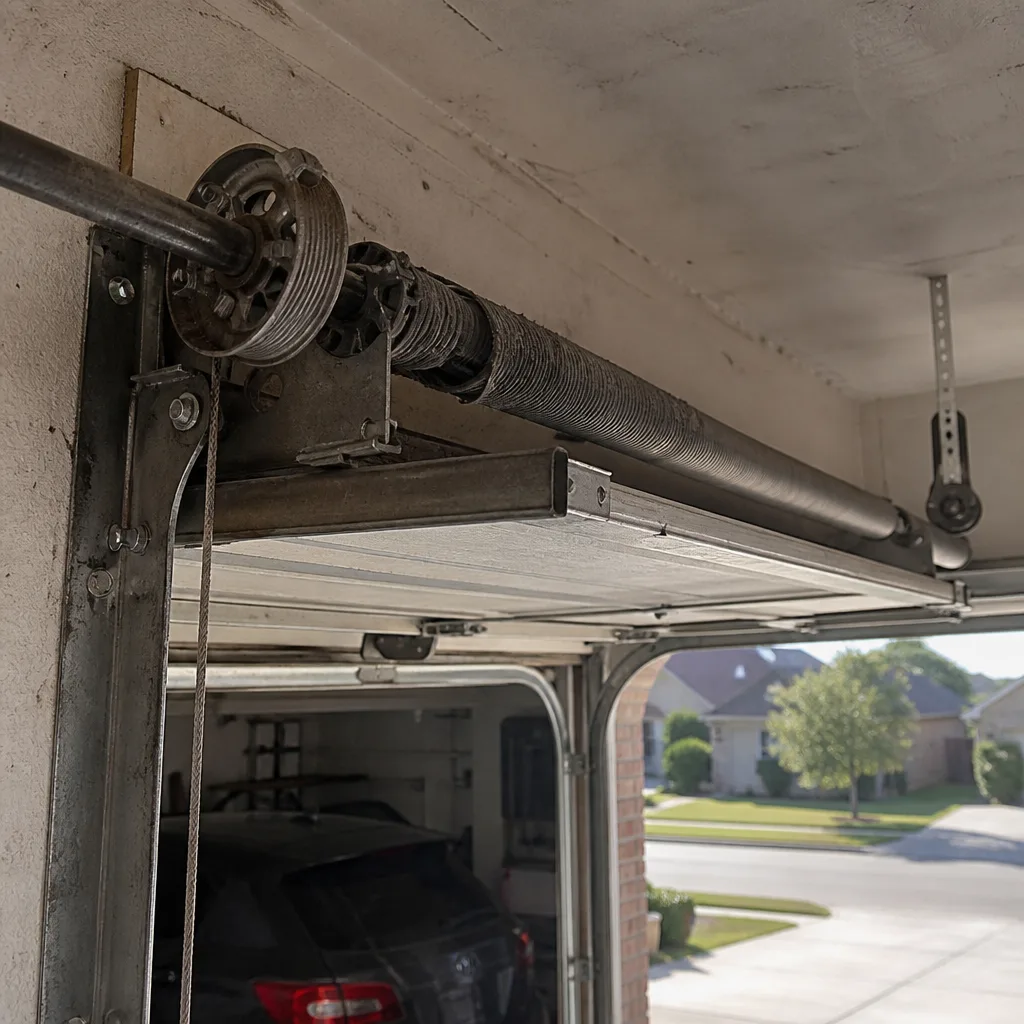 Before
 After
After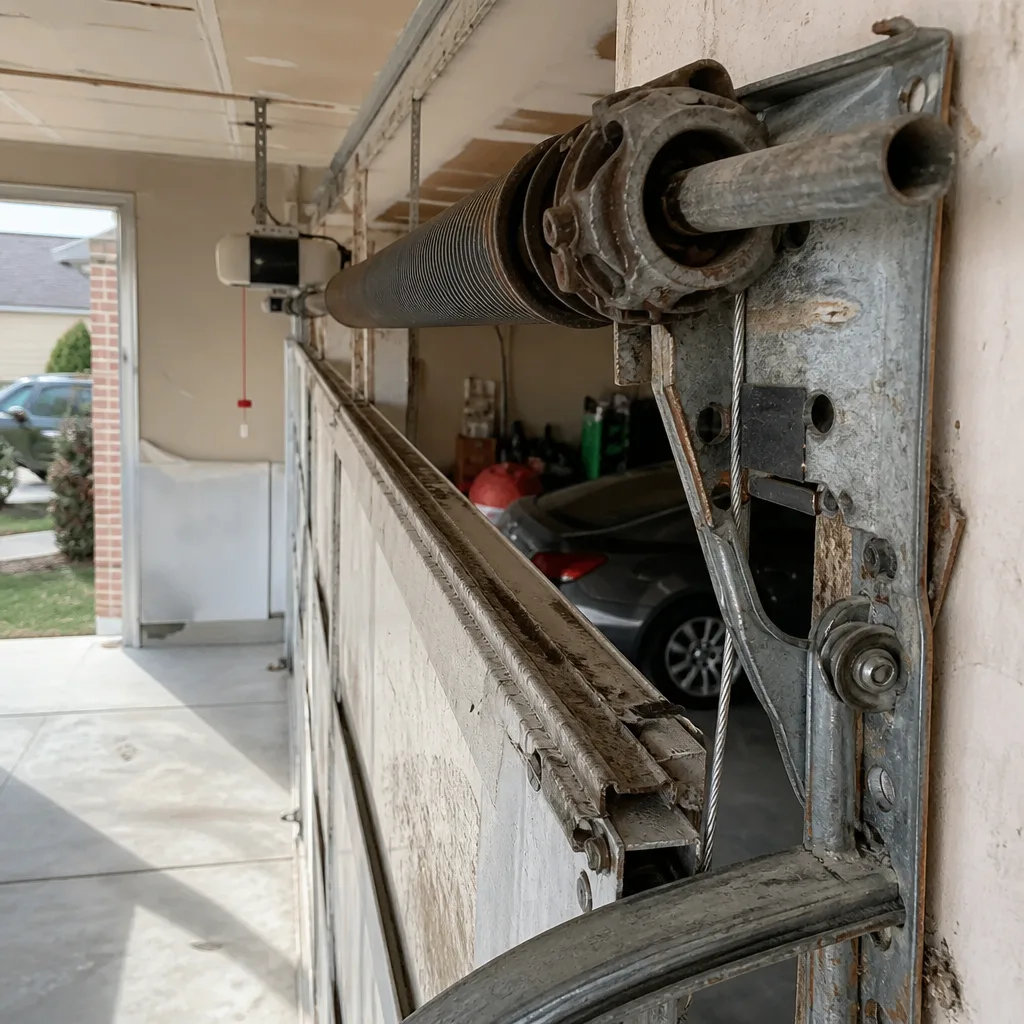 Before
 After
AfterGarage Door Warning Signs: A McKinney Homeowner’s Reference Guide
Here’s something most McKinney homeowners don’t realize until it’s too late: your garage door has been telling you it’s failing for weeks before it actually does. That slight hesitation three inches off the ground, that new rattle you only hear on Tuesday mornings, that faint grinding you’ve started tuning out. None of it is normal, and none of it fixes itself. What follows is The Complete Guide to Garage Door in McKinney Otto Reinhardt has been building in his head since 2004, the same year he started Otto’s Garage Door and began answering calls from McKinney homeowners standing in their driveways, staring up at a door that just quit. By the time you finish reading, you’ll know exactly what your door is saying and whether it can wait until payday or needs attention tonight.
Quick Answer
The most common garage door warning signs in McKinney are a door that hesitates or jerks while moving, grinding or squealing sounds during operation, visible rust below the cable drums, daylight showing through the weatherstripping, and an opener that runs but strains to lift. For a deeper walkthrough, see How to Hire a Garage Door Contractor in McKinney: A Step-by-Step Guide. A hesitating door usually means a torsion spring has lost tension, and a grinding noise typically points to worn rollers. If your door slams when closing or won’t reverse when it hits an obstruction, stop using it and call a professional immediately.
Table of Contents
- The Sound-to-Problem Index: What Your Door Is Actually Saying
- Visual Warnings You’re Probably Walking Past Every Morning
- Opener Behavior: Electrical Trouble vs. Mechanical Trouble
- The Safety Reversal Test Every McKinney Home Should Run
- Emergency vs. Schedule-It-This-Week: The Three Call-Right-Now Conditions
- What McKinney Weather Does to Garage Doors
- What Waiting Actually Costs: A Timeline of Deferred Repairs
- Common Mistakes to Avoid
- When to Call a Professional
- Frequently Asked Questions
The Sound-to-Problem Index: What Your Door Is Actually Saying
A garage door makes three kinds of sounds: the ones it’s supposed to make, the ones that mean “lubricate me,” and the ones that mean “something is about to break.” Most people lump them all together and ignore them. That’s a mistake, because each sound maps to a specific component, and each component has a specific repair cost that only climbs the longer you wait.
Here in McKinney, we hear the full range on service calls. A door grinding on its tracks in Stonebridge Ranch sounds different from one grinding in Craig Ranch, but the cause is usually the same: rollers that have worn flat or lost their bearings. Here’s the index Otto uses when a homeowner calls and holds the phone up to the garage:
- Grinding or a low rumble: Almost always the rollers. Metal rollers with worn bearings grind against the track. Nylon rollers that have gone flat rumble. This is a $130 to $210 fix if caught early, and we carry the rollers on the truck. Wait too long and the roller seizes, which drags the door sideways and can bend the track, and now you’re looking at $350 or more.
- Squealing or high-pitched shrieking: Dry metal on metal. Could be the hinges, could be the torsion spring itself, could be the opener’s chain or screw drive. This one is often addressed with lubrication, but if the squeal comes from the spring, you’re hearing coil friction that accelerates wear. A spring that’s squealing is a spring that’s failing. Don’t DIY this one. A torsion spring under tension can break a forearm, a jaw, or worse.
- Banging or a sharp pop during operation: Two possible culprits. First, a loose panel hinge or a panel that’s begun to separate from its stile. Second, and more serious, a torsion spring that’s slipping or catching. A single loud bang followed by a door that won’t open is the classic signature of a spring that has snapped. You’ll know it immediately, and if you were in the garage when it happened, you won’t forget the sound.
- Thumping or rhythmic bumping as the door moves: One section of the door is out of alignment or a roller has jumped the track slightly. The door is climbing over its own hardware. This one gets worse fast because every cycle exaggerates the misalignment.
- A whooshing or flapping sound: The bottom seal or side weatherstripping has torn loose and is catching the wind. Not a mechanical emergency, but in McKinney’s heat, that gap is pumping hot air into your garage all day. Fixing the seal is cheap; ignoring it isn’t.
The rule of thumb Otto tells every McKinney homeowner: if you can hear the door from inside the house with the garage door closed, something has changed. Doors don’t get louder for no reason. For a full breakdown of what a repair visit looks like, see our Garage Door Repair in McKinney page.
Visual Warnings You’re Probably Walking Past Every Morning
Most McKinney homeowners pull out of the garage, hit the button, and never look back. But if you turned around once a week and actually looked at the door while it operates, you’d catch half the problems we get called for after they’ve already become emergencies. Here’s what to look for:
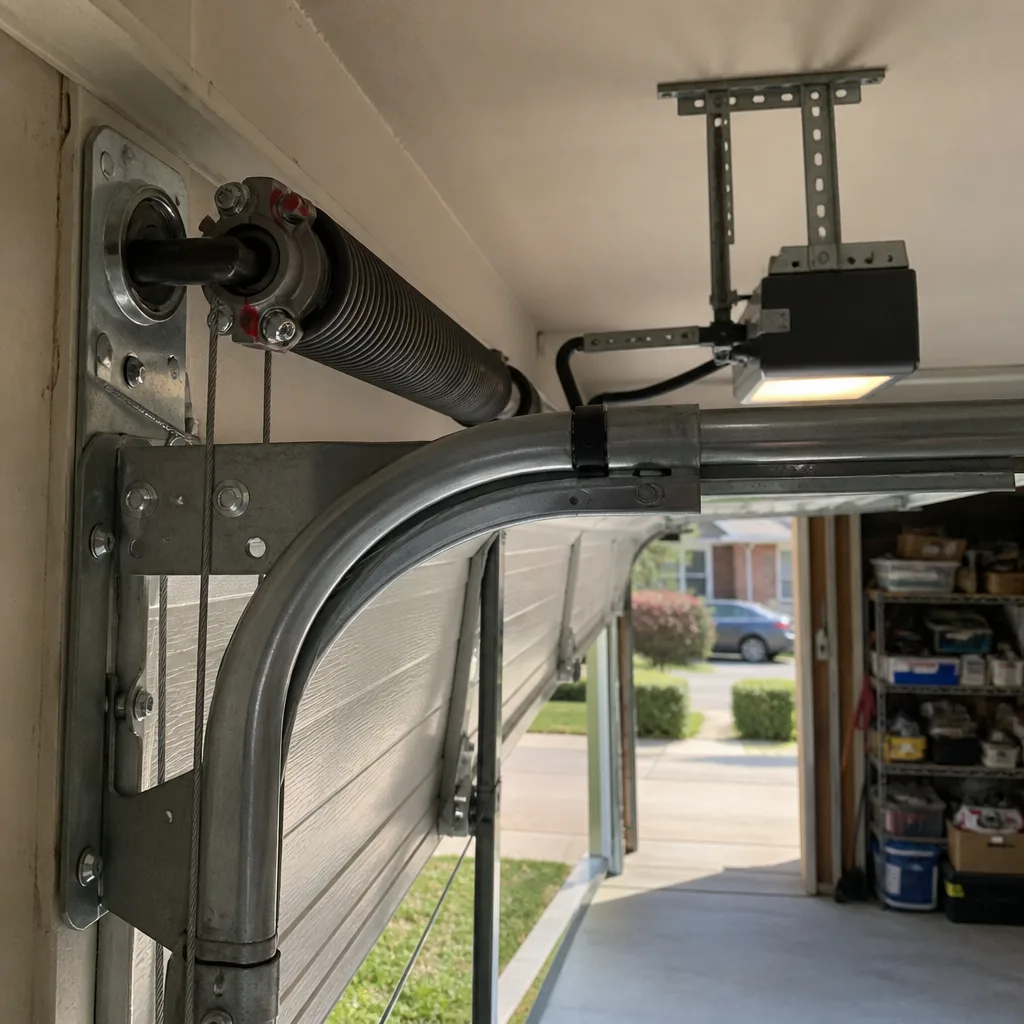
Rust streaks below the cable drums. Follow the cables from the bottom corners of the door up to the drums at the top. If you see reddish-brown streaks running down from the drums or along the cables themselves, that’s metal degrading under load. The cables are what connect your door to the springs, and when a cable snaps, the door drops or slams sideways. In McKinney’s humidity, which sits above 60% for most of the spring and summer, this rust happens faster than you’d think. We see cable-drum corrosion on doors that are five years old in some McKinney neighborhoods, especially west-facing garages that catch the afternoon sun and then cool rapidly at night, creating condensation cycles.
Daylight showing at the corners. Stand inside the garage with the light off and the door closed. Can you see daylight at any corner or along the top edge? That gap means the weatherstripping has compressed, cracked, or pulled away. It’s not just an energy issue, though in a McKinney August that gap is feeding 100-degree air into your garage. It’s also an entry point for insects, dust, and in wet springs, water. Weatherstripping is the cheapest thing on the whole door to replace, and the most commonly ignored.
A door that sits crooked in the frame. Close the door and look at the gap between the bottom of the door and the garage floor. Is it even from left to right? If one side is tighter than the other, one of three things is happening: a spring has lost tension on one side, a cable has stretched, or a track has shifted out of plumb. All three are fixable, none of them are DIY jobs. A door that sits crooked is working against itself on every single cycle, and that’s how a $200 fix becomes a $700 track and panel replacement.
Sagging panels or cracks in the door face. On sectional doors, each panel is connected to the next by hinges. If you see a visible dip in the door line when the door is halfway up, a hinge is wearing out or a panel stile has cracked. Amarr and Clopay doors hold up well in McKinney’s climate, but nothing lasts forever, and the first sign of panel failure is usually visible from the driveway if you know what you’re looking at.
If the door you’re looking at is beyond the point of sensible repair, our Garage Door Installation in McKinney page walks through what a replacement actually costs, measured and written before any work begins.
Opener Behavior: Electrical Trouble vs. Mechanical Trouble
Here’s the distinction that saves McKinney homeowners hundreds of dollars: when the opener misbehaves, the problem is usually mechanical, not electrical. The opener is a motor with a logic board. It’s a simple machine. The door itself is 200 pounds of steel, aluminum, or wood riding on two springs, and when something on the door side of the equation goes wrong, the opener is the messenger that gets blamed.
When Otto pulls up to a house because “the opener is straining,” the first thing he checks is the door balance. He disconnects the opener with the release cord, lifts the door manually to waist height, and lets go. A properly balanced door stays put. A door that falls or flies up has a spring problem, not an opener problem. That distinction matters because:
- A spring repair is typically $180 to $340, done in one visit.
- An opener replacement is $450 to $700, and if you replace the opener without fixing the underlying spring condition, the new opener fails prematurely because it’s fighting the same unbalanced load.
Electrical trouble signals: The opener hums but doesn’t move (a capacitor or motor issue), the lights flicker when the opener runs (a wiring or circuit board issue), the opener loses its settings after every power outage (a logic board problem), or the wall button and remotes both stop working at once (power supply or board). These are genuine opener problems and they usually mean opener repair or replacement.
Mechanical trouble signals (the door, not the opener): The opener runs but the door moves slowly or jerkily, the opener reverses immediately after starting to lift, the opener shuts off mid-cycle with no apparent reason, or you hear the motor laboring harder than it used to. In most cases, what you’re hearing is a motor compensating for a failing spring or a binding track. The fix is on the door side, and it’s usually less expensive than you fear.
If you want to see what a properly functioning opener installation looks like, our Garage Door Opener in McKinney page covers the brands we work with, including Genie, LiftMaster, and Chamberlain.
One more McKinney-specific note: power surges from thunderstorms are a real thing here, and they can scramble a logic board. If your opener worked fine until the last storm rolled through, unplug it for sixty seconds and plug it back in before you assume the worst. That simple reset fixes more openers than you’d believe.
The Safety Reversal Test Every McKinney Home Should Run
Since 1993, every garage door opener sold in the United States has been required to include a safety reversal system. That system has one job: if something, anything, blocks the door’s path while it’s closing, the door should stop and reverse within two seconds. Children, pets, a trash can, a bicycle. The opener doesn’t care. It should reverse.
But here’s what the instruction manual doesn’t tell you: that safety reversal system runs on force settings. The opener’s logic board is told “this is how much resistance the door should encounter on the way down.” If the force setting is tuned too high, the door will push through an obstruction instead of reversing. Force settings drift over time, especially on older openers, and they drift in the wrong direction. A door that reversed properly in 2018 might not reverse properly in 2025.
Here’s the test, and it takes two minutes:
- Place a 2×4 flat on the garage floor, directly in the path of the closing door.
- Press the button to close the door.
- Watch what happens when the door contacts the 2×4.
- If the door reverses within two seconds of contact, your safety reversal is working. If the door stalls, hesitates, or continues to apply pressure, the reversal system has failed.
Run this test once a month. Write it on the calendar next to the smoke detector battery check. In a house with children or pets, a failing safety reversal isn’t a maintenance item, it’s a liability. If the door doesn’t pass the test, disconnect it from the opener and call us. This is not a repair that waits for the weekend.
The liability angle is real. If a child is injured by a garage door whose reversal system had failed, the homeowner carries that weight. The repair to fix a force setting is usually under $100. The alternative isn’t worth thinking about.
Emergency vs. Schedule-It-This-Week: The Three Call-Right-Now Conditions
Otto answers the phone at nine at night because sometimes that’s when the spring lets go and the vehicle is sealed inside. He doesn’t ask you to leave a message. He answers. But not every warning sign is an emergency, and calling at 2 a.m. for a squeaky roller doesn’t help anyone. Here’s the triage:
Call right now, day or night, if any of these three conditions are present:
- The door won’t open and your car is trapped inside. In McKinney, where most homes use the garage as the primary entry point, this is a life logistics emergency. Otto’s had calls at 5:30 a.m. from homeowners who needed to get to work at the hospital in McKinney, and he’s been there within the hour. If your vehicle is sealed inside, get off the driveway and call (945) 777-4688.
- The door has come off its track or is hanging at an angle. A door that’s partially off its track is one cycle away from falling. Two hundred pounds of door coming down on a car, a workbench, or a person is a serious event. Don’t try to straighten it. Don’t run the opener. Step back and call.
- A cable has snapped or is visibly frayed to the point of imminent failure. Cables under tension don’t give second chances. If you can see a cable that’s unraveling, the door is a loaded weapon. This is the one where Otto says the same thing every time: get off the driveway, close the garage if you can do so without going under the door, and call now.
Schedule it this week if: The door is noisy but operating, the weatherstripping has gaps, the door sits slightly crooked but still cycles, or you’ve noticed a new rattle. These are real problems, but they’re not going to hurt anyone tonight. Call us during business hours, we’ll quote the job on the phone, and we’ll hold that price when we show up.
Every repair from Otto’s Garage Door comes with the 90-Day Done Right Promise written on the invoice. That’s ninety days in writing, not in a marketing brochure. If it’s not done right, Otto makes it right. One call, no runaround.
What McKinney Weather Does to Garage Doors
McKinney sits in Collin County, where summers run hot and humid, winters bring occasional freezes, and spring storms roll through with real violence. All of that lands on your garage door, which is the largest moving object on the house and the one most exposed to the weather. For year-round maintenance tips, see our Seasonal Garage Door Care for McKinney: Year-Round Homeowner’s Guide.
Summer heat: McKinney regularly sees stretches of 100-degree days in July and August. That heat does two things to a garage door. First, metal components expand, and when they cool at night, they contract. That daily cycle loosens hardware, fatigues springs, and accelerates wear on bearings. Second, the heat inside a closed garage can push temperatures above 110 degrees, which cooks the lubricant off the moving parts. A door that’s well-lubricated in April can be running dry by July. We recommend lubricating hinges, rollers, and springs twice a year in McKinney, not once, because our summers burn through lubricant faster than the national average.
Spring storms: Collin County gets its share of severe weather. High winds can shift a garage door in its tracks if the door is open during a storm. Hail can dent panels, and a dented panel can bind against the door next to it. If you’ve watched hail come down on your driveway, give the door a visual once-over afterward. Check the panel faces for dents, watch the door cycle once, and listen for anything that wasn’t there before.
The occasional freeze: McKinney doesn’t get Minnesota winters, but we do get hard freezes, and in 2021 this whole area learned what happens when systems fail under ice. For a garage door, the freeze risk is mostly at the bottom seal. If water pools at the base of the door and then freezes, the door can stick to the floor. That first cycle in the morning yanks the door free hard, which snaps cables and bends tracks. Before you hit the button on a frozen morning, check that the bottom seal isn’t iced to the concrete. A quick visual glance can save you a $300 repair.
Wayne Dalton and Amarr doors are common in McKinney, and both handle this climate reasonably well when maintained. No door made ignores this weather entirely.
What Waiting Actually Costs: A Timeline of Deferred Repairs
Here’s the part that stings, and the reason Otto built his business on giving McKinney homeowners straight answers before they’re standing in a broken garage. The cost of a garage door repair is almost never higher than the cost of waiting. Here’s what the timeline looks like for the most common deferred repairs:
Worn rollers: $130 to $210 to replace all of them today. Wait until one seizes: $350 to $500 for the roller replacement plus track straightening, and sometimes a new track section entirely. Six months of ignoring the grinding is the difference between a simple parts swap and a half-day repair.
A sagging or straining spring: $180 to $340 to replace the pair today, before one breaks. Wait until it snaps on a Tuesday morning with your car inside: same replacement price, plus a possible same-day scheduling headache, plus whatever the day costs you when you can’t get the car out. The spring costs the same whether you replace it before or after it breaks. The only variable is what else breaks when it goes.
Torn weatherstripping: $75 to $120 today. Wait a season: the gap lets McKiner’s humidity and insects in, your garage gets hotter, and if you use the garage as a workshop or gym, your comfort bill climbs. Still cheap to fix, but you’ve spent months with a worse garage for no reason.
A problematic logic board in the opener: $150 to $250 to replace the board. Wait until the board fails completely: $450 to $700 for a new opener, because when the board dies, the motor and rail usually aren’t worth salvaging. If your opener is losing its settings or the wall button has stopped communicating with the unit, that’s the board warning you. Listen to it.
Every one of these is a repair Otto quotes on the phone before he ever gets in the truck, and that number doesn’t change when he’s standing in your driveway. He’s held that policy since 2004, and it’s why McKinney homeowners keep his number in their phone.
Common Mistakes to Avoid
- Lubricating the door with WD-40. WD-40 is a solvent, not a lubricant. It strips whatever lubrication was there and leaves the metal drier than before. Use a white lithium grease or a silicone-based garage door lubricant on hinges and rollers, but never on the spring itself unless you’re confident in what you’re doing. The spring is under tension, and hands belong nowhere near it.
- Continuing to use the door after a suspicious sound appears. Every cycle with a failing component accelerates the failure. That grinding roller is chewing up the track. That unbalanced spring is fatiguing both springs, not just one. When the sound changes, the clock is running.
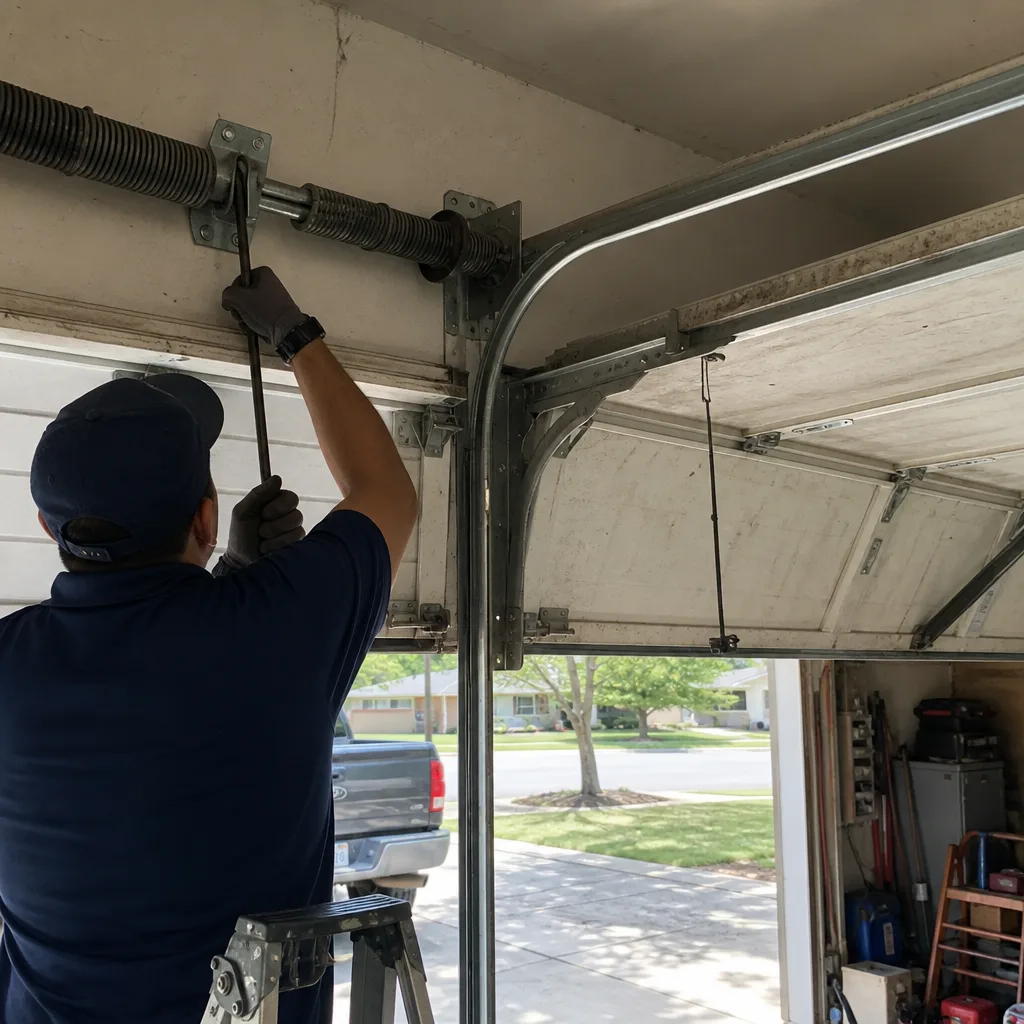
- Trying to replace a torsion spring without the right tools. This is the one repair that sends people to the emergency room on a regular basis. A torsion spring holds enough energy to break bone. The winding bars and the technique are non-negotiable. If you don’t have both, you don’t have a repair plan.
- Adjusting the opener’s force settings to “fix” a door that’s binding. Cranking up the force setting on an opener when the door is fighting itself creates a door that will push through an obstruction instead of reversing. You’re not fixing the problem, you’re creating a danger.
- Assuming a crooked door is a cosmetic issue. A door that sits unevenly is a door that’s under stress. It will not correct itself, and it will cost more to fix in six months than it costs to fix today.
- Ignoring the door because it’s “old but still working.” An old door that’s still working is a door that has been maintained. Those are the ones that last. When they stop working, it’s usually sudden and it’s usually a spring or a cable. The age of the door matters less than the condition of the components, and components can be replaced.
If you’ve been putting off a repair and want a second opinion on an estimate you’ve already received, Otto’s Garage Door offers a Free Second Opinion on any written estimate, no trip charge inside Collin County. Bring it in, and we’ll tell you straight whether the price is fair and whether all of it is even necessary.
When to Call a Professional
Some jobs are Saturday-morning projects. A garage door repair is not one of them. If your door is making a new sound, sitting crooked, not reversing properly, or has visible cable or spring damage, call someone who does this every day. The cost of a service call is always less than the cost of guessing wrong on a component that’s holding 200 pounds of door over your head. Otto’s Garage Door offers free estimates in McKinney, and the price Otto quotes on the phone is the price on the invoice when the job is done. Call (945) 777-4688 and you’ll talk to a live person, not a menu. If it’s nine at night and your spring just let go with the car inside the garage, Otto answers anyway. That’s been the deal since 2004.
Frequently Asked Questions
Most garage door repairs in McKinney run between $130 and $340, depending on the component. Roller replacement typically costs $130 to $210, torsion spring replacement runs $180 to $340, and weatherstripping is usually $75 to $120. Opener replacement runs higher, from $450 to $700. Every price is quoted and agreed before any work starts, and the number doesn’t change when we arrive. Call (945) 777-4688 for an exact quote, estimates are free.
Yes. Otto’s Garage Door provides 24/7 emergency service in McKinney, and a live person answers the phone around the clock. If your vehicle is trapped inside the garage, that’s a priority call. Call (945) 777-4688 and Otto will quote the job on the phone and hold that number at the door.
No. The price quoted on the phone is the price on the invoice, period. That’s been Otto’s policy since 2004, and it’s written into how he operates. If something unexpected comes up during the repair, he stops and calls you before any additional work happens. You’ll never get a surprise bill at the end.
Otto’s trucks are stocked with the parts needed for the overwhelming majority of McKinney garage door repairs: rollers, hinges, cables, springs, weatherstripping, and common opener components across Genie, Clopay, Amarr, and Wayne Dalton brands. Most jobs are finished in one visit.
Given McKinney’s summer heat and storm season, twice a year is the right cadence. For more guides & resources, visit our blog. The spring (after freeze season) and the fall (after the summer heat) are the two times when wear is most visible. An inspection catches failing rollers, dry hinges, and rust before they become a breakdown.
It depends on the noise. Squealing is usually a lubrication issue and is not immediately dangerous, though it accelerates wear. Grinding is rollers failing and will become dangerous if a roller seizes. Banging is either a loose panel or a spring issue, and a spring issue is dangerous. Any new noise should be checked. Call (945) 777-4688 and describe it. Otto will tell you over the phone whether it can wait or needs attention now.
The Bottom Line
A garage door in McKinney talks before it fails. The hesitation, the grinding, the crooked kiss of the door against the frame, the rust streak below the cable drum. These are not quirks. They’re warnings with names, causes, and timelines, and every one of them costs less to fix today than it will after the failure. You don’t need to become an expert. You need to know when to stop ignoring the sound and start making a call. Otto’s Garage Door has been serving McKinney since 2004, and the number hasn’t changed: (945) 777-4688. A live person answers, Otto quotes the job on that call, and the price holds when he gets there. If you’d rather keep your twenty-year customer than chase a new one, you run the business that way. That’s the whole philosophy behind the Otto’s Garage Door home operation, and it’s why the van says what the license says.
Written by Otto Reinhardt, Owner at Otto’s Garage Door, serving McKinney since 2004.